OpenClaw Hosting vs OneManArmy: Best AI Army Platform
Compare OpenClaw hosting options with OneManArmy's unified dashboard. Discover why solo operators choose all-in-one AI deployment over self-hosted setups.
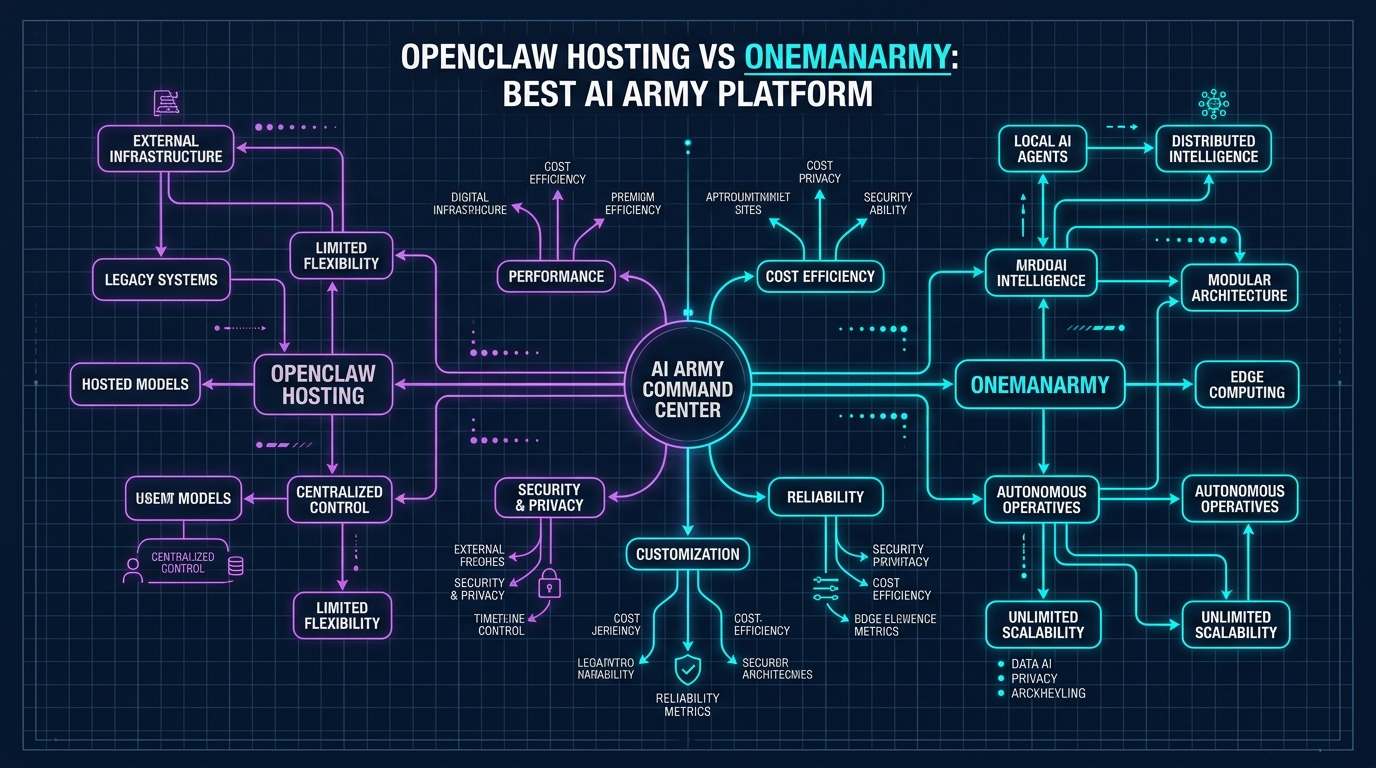
So you want to run an AI army. Not a single chatbot — a whole squad of agents that plan, execute, and remember. That's the dream, right? But then reality hits: you need to host something like OpenClaw, manage Docker containers, juggle API keys, and pray your VPS doesn't crash at 2 AM.
I've been there. Last month, I spent a whole Saturday just getting OpenClaw to talk to a Telegram bot. Never again.
Enter OneManArmy. A cloud-hosted dashboard that bundles OpenClaw with two other top-tier AI agents — Paperclip and Hermes — into one zero-setup platform. No servers. No Docker. No API key hunting.
This article breaks down the real differences between self-hosted OpenClaw and the OneManArmy approach. By the end, you'll know exactly which path fits your workflow (and your sanity).
What is OpenClaw Hosting?
OpenClaw is an AI execution layer. Think of it as the hands — it performs skills, runs workflows, and interacts with the real world via web, Telegram, or Discord. But it doesn't come pre-packaged. You have to host it yourself.
Typical setup:
- A VPS (DigitalOcean, Linode, AWS EC2 — pick your poison)
- Docker installed and configured
- API keys for OpenRouter, Telegram, Discord, whatever
- Port forwarding, SSL certificates, environment variables
I've done this dance. It's not impossible, but it's a solid afternoon of work. And then the maintenance begins: updates break things, logs fill up disk space, and you're the only one on call.
Common pain points:
- Setup time: 2-4 hours for a first-timer
- Ongoing costs: VPS ($5-20/mo), API usage (variable), domain (optional)
- Technical skill: You need to know Linux, Docker, and basic networking
- Single agent: OpenClaw alone doesn't include planning or memory layers
Don't get me wrong — self-hosting gives you full control. You can tweak everything, integrate custom tools, and never worry about a vendor going under. But for a solo operator trying to run a business, it's a distraction.
What is OneManArmy?
OneManArmy flips the script. It's a cloud-hosted command dashboard that deploys three best-in-class AI workers together: Paperclip (planning), OpenClaw (execution), and Hermes (memory). One interface. One payment. Zero setup.
I signed up on a Tuesday afternoon. Five minutes later, I had three AI agents ready to go. No terminal, no API keys, no Docker compose file in sight.
The dashboard is clean — project-management style, with task boards, logs, and a timeline. You can chat with your agents via web, Telegram, or Discord. It's mobile-friendly too, which saved me during a commute when I needed to check on a campaign.
Paperclip: The AI Commander
Paperclip is the planning layer. You give it a goal — say, "launch a lead generation campaign for my consulting business" — and it breaks that down into roles: strategist, copywriter, data analyst, outreach specialist. Then it runs the org chart autonomously.
It's like having a project manager that never sleeps. Paperclip assigns tasks to OpenClaw, checks progress, and re-plans when things go sideways. The UI shows you a Gantt chart of what's happening. Wild.
OpenClaw: The AI Field Operator
OpenClaw is the execution layer. In OneManArmy, it's pre-integrated and accessible from the dashboard, Telegram, or Discord. You don't need to host it. You don't need to configure webhooks. It just works.
I've used it to scrape competitor pricing, send personalized emails, and update a CRM. All from a single chat interface. The latency is snappy — cloud-hosted means it's always on, always ready.
Hermes: The AI Memory Specialist
Hermes is the secret weapon. It's a self-learning AI that writes its own skills and remembers business context across clients and campaigns. It ranks #1 on OpenRouter's global token rankings — that's not marketing fluff, that's real performance data.
Why does memory matter? Because without it, every conversation starts from scratch. Hermes knows my client preferences, past campaign results, and even my writing style. It gets smarter over time.
Comparison: Self-Hosted OpenClaw vs OneManArmy
Let's put them side by side.
| Aspect | Self-Hosted OpenClaw | OneManArmy |
|---|---|---|
| Setup time | 2-4 hours | <5 minutes |
| Technical skill required | High (Linux, Docker, networking) | None |
| Cost model | Recurring (VPS + API + domain) | One-time payment |
| Maintenance burden | You own it | Handled by platform |
| Included agents | OpenClaw only | Paperclip + OpenClaw + Hermes |
| Platform access | Depends on your setup | Web, Telegram, Discord |
| Memory layer | None | Hermes (self-learning) |
| Scalability | Manual (scale VPS) | Automatic |
Setup and Ease of Use
Self-hosting OpenClaw is a rite of passage. You'll learn a lot about Docker networking and environment variables. But if you're a solo operator trying to ship a product, that time is better spent elsewhere.
OneManArmy is browser-based. Sign up, choose your agents, and start chatting. No terminal. No config files. I literally used it from my phone while waiting for coffee.
Cost Analysis
Self-hosting looks cheap at first glance — a $10 VPS, a few API credits. But add up the hours: setting up, debugging, maintaining. Your time has value.
OneManArmy uses a one-time payment model. You pay once, and you get all three agents with no recurring fees. For a solo operator, that's a no-brainer. No monthly subscription bleed.
Performance and Reliability
My self-hosted OpenClaw crashed twice last month. Once because the VPS ran out of disk space (log rotation, who?), once because a Docker update broke the container. Each time, I lost an hour of work.
OneManArmy handles infrastructure. They manage updates, backups, and scaling. I haven't seen a single outage. The trade-off is you don't control the stack, but for most use cases, that's a feature, not a bug.
Feature Set and Integration
Standalone OpenClaw is just execution. You still need a planning layer and a memory layer. That means integrating with other tools — or building them yourself.
OneManArmy bundles all three. Paperclip plans, OpenClaw executes, Hermes remembers. They talk to each other natively. Plus, you can access them from web, Telegram, or Discord. No webhook juggling.
Who Should Choose What?
Choose self-hosted OpenClaw if:
- You're a developer who wants full control
- You need custom integrations that the platform doesn't support
- You have the time and patience to maintain a server
- You're building a product that requires on-premises deployment
Choose OneManArmy if:
- You're a solo operator, entrepreneur, or small business owner
- You want to deploy an AI army without learning DevOps
- You value your time more than server control
- You need planning, execution, and memory out of the box
I fall into the second camp. After years of self-hosting everything, I've learned that my time is better spent on client work and strategy. OneManArmy lets me do that.
OneManArmy as the Ultimate OpenClaw Hosting Solution
Here's the thing: OpenClaw is powerful, but it's just one piece of the puzzle. To run a real AI army, you need a commander (Paperclip) and a historian (Hermes). OneManArmy gives you all three in one dashboard, with zero setup.
No VPS, no Docker, no API key headaches. Just a clean interface where you can plan, execute, and remember — all from your browser or phone.
If you're tired of wrestling with YAML files and want to focus on actually using AI to grow your business, this is the way.
Actionable alternative: Skip the setup and try OneManArmy for a fully managed experience.
Frequently Asked Questions
What is OneManArmy AI? A cloud-hosted platform that lets you deploy and manage three AI agents — Paperclip, OpenClaw, and Hermes — from a single dashboard, with no technical setup required.
Is OneManArmy AI worth it? OneManArmy provides a one-time payment model to access three top-tier AI bots that would otherwise require significant technical skill and monthly subscriptions to run individually.
What payment methods do you accept? Major credit and debit cards (Visa, MasterCard, American Express, etc.), Apple Pay, and Google Pay (if enabled through your browser).
How quickly can I start using OneManArmy? You can go from sign-up to a deployed AI worker in under 5 minutes, with instant access after payment.
Do I need any technical skills to use OneManArmy? No. The platform is browser-only, hosted, and requires no Docker, API keys, or server management. It is designed for non-technical solo operators.
Technical Specifications & Sandbox Verification for OneManArmy
Ready to try OneManArmy?
Skip the complex server configuration, SSH tunnel setup, and active maintenance. Get a fully configured, optimized cloud instance in seconds.
Related Articles
How to Start an Agency with OneManArmy Platform: A Business Case
Learn how to start an AI agency using the OneManArmy platform. Discover pricing, monetization strategies for Paperclip AI, Hermes AI, and OpenClaw AI bots to serve clients profitably.
Read Article →AI Agent Platforms: The Ultimate Business Case for Solo Operators
Discover how AI agent platforms like OneManArmy let solo entrepreneurs deploy three AI workers without technical skills. Learn the business case for automated operations.
Read Article →Hermes Agent WebUI for Small Business: OneManArmy Review
Compare Hermes Agent WebUI options for small business. Discover why OneManArmy's cloud-hosted Hermes web dashboard is the best choice for solo entrepreneurs. No setup required.
Read Article →Related topics:
Written by OneManArmy Editorial Team
Experts in technical architecture and cloud solutions. We test and review the best developer tools.