Hermes Agent vs OpenClaw: Which AI Worker Fits Your Solo Army?
Compare Hermes Agent vs OpenClaw in the OneManArmy ecosystem. Discover how their strengths—memory & autonomy vs execution & accessibility—help solo operators.
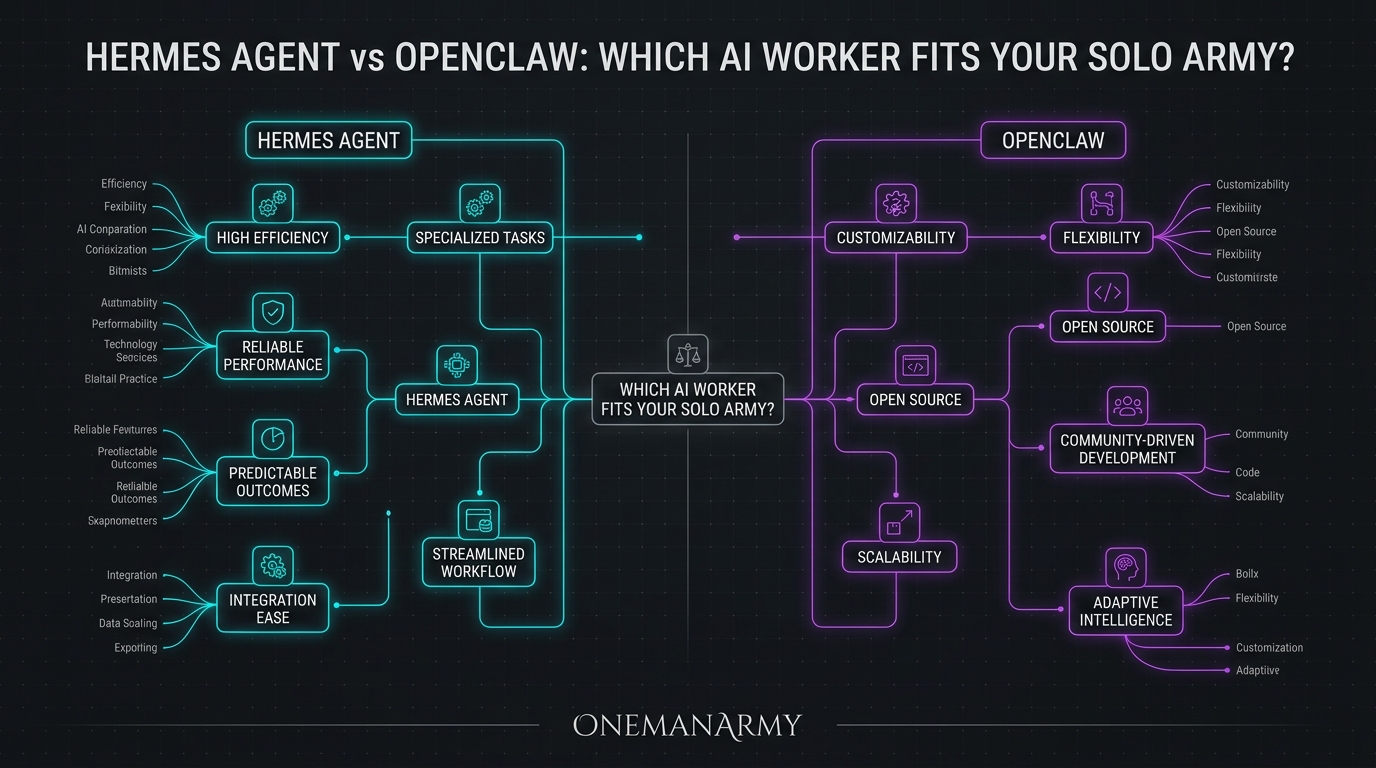
I run a one-man shop. Client work, content, outreach — the whole deal. For months I bounced between ChatGPT tabs and half-baked automations. Then I found OneManArmy. And suddenly I had two AI workers staring at me: Hermes Agent and OpenClaw.
Nope, you don't pick one. They're designed to be a team. But understanding each one's strengths is the difference between a smooth workflow and a janky mess. Let me break it down from the trenches.
What Are Hermes Agent and OpenClaw?
Both live inside the OneManArmy dashboard. Zero setup. No Docker. No API key hunting. You sign up, you get a control panel with three AI workers: Paperclip (the planner), Hermes (the memory specialist), and OpenClaw (the execution layer).
Hermes is the brain that learns. It wrote its own skills after a few hours of me feeding it client data. It remembers context across campaigns — which client hates formal tone, which one needs weekly reporting. OpenClaw is the hands. It executes tasks in the real world: sending messages, scraping websites, updating spreadsheets. It's accessible via web, Telegram, or Discord.
Hermes Agent: The Self-Learning Memory Specialist
Hermes ranks #1 on OpenRouter's global token rankings. That's not marketing fluff — it means the model is efficient and smart. But the killer feature is its memory. It writes its own skills. I gave it a prompt about my client onboarding process, and it generated a custom skill that now handles new client intake automatically.
Last Tuesday, I was deep in a campaign for a SaaS client. I asked Hermes to draft an email sequence based on our previous conversations about their ICP. It pulled context from three months ago — the pain points we'd discussed, the tone they preferred, the offer that converted. No re-explaining. That's the magic.
OpenClaw: The Execution-First Field Operator
OpenClaw doesn't learn. It acts. You give it a task, it executes. I use it for daily operations: checking competitor prices, posting to Telegram groups, scraping lead lists. It's a workhorse.
The classic trap — I fell into it in production — is asking OpenClaw to do something that requires memory. It won't remember yesterday's output. That's Hermes' job. OpenClaw is session-based. But for speed and integration, it's unmatched. I can ping it on Discord: "OpenClaw, check if the staging server is up." Done.
Head-to-Head Comparison: Key Differences
| Feature | Hermes Agent | OpenClaw |
|---|---|---|
| Autonomy | Self-learning, writes its own skills | Instruction-following, executes predefined tasks |
| Memory | Long-term context across clients and campaigns | Session-based, no persistent memory |
| Access | Primarily web dashboard | Web, Telegram, Discord |
| Use Case | Research, strategy, content creation, client history | Task execution, automation, messaging integrations |
| Setup | Zero (within OneManArmy) | Zero (within OneManArmy) |
| Learning Curve | Requires initial context feeding | Straightforward, prompt-and-go |
When to Use Hermes Agent (and When to Use OpenClaw)
Here's my rule of thumb. If the task needs context, history, or reasoning — Hermes. If it needs speed, execution, or integration with a messaging app — OpenClaw.
Real scenario: I'm running a lead generation campaign for a local business.
- I ask Hermes: "Analyze our past campaign data and suggest a new outreach sequence for similar clients." It pulls memory from the last campaign, identifies what worked, and drafts a strategy.
- I then tell OpenClaw on Telegram: "Execute the outreach sequence Hermes just drafted. Start with the list of leads in the spreadsheet." OpenClaw executes immediately.
After two hours of debugging my YAML configs on a previous solo tool, I finally found the culprit — the tool had no memory layer. Hermes eliminates that pain. OpenClaw eliminates the execution bottleneck.
Why You Don't Have to Choose: The OneManArmy Advantage
Here's the thing. OneManArmy gives you both. Plus Paperclip, which plans the whole operation. You don't need to decide between memory and execution. You get a unified dashboard where Hermes' outputs feed directly into OpenClaw's tasks.
No technical setup. No juggling API keys. No maintaining servers. It's a cloud-hosted platform ready in under five minutes. For a solo operator, that's gold. I spent weeks trying to wire together a similar setup with Docker and custom scripts. OneManArmy does it out of the box.
Actionable alternative: Skip the setup and try OneManArmy for a fully managed experience.
Frequently Asked Questions
Can Hermes and OpenClaw work together?
Absolutely. They're designed to complement each other. In the OneManArmy dashboard, you can chain them: Hermes generates a strategy, and OpenClaw executes it. No manual handoff needed.
Which is better for beginners?
OpenClaw is easier to start with — just give it a task. But Hermes' memory is a game-changer once you have a few weeks of context. Start with OpenClaw, then feed Hermes your history.
Do I need technical skills to use either?
No. OneManArmy is browser-only. No Docker, no API keys, no server management. You sign up, you're in.
How does the pricing work for both in OneManArmy?
OneManArmy offers a one-time payment model. You get all three workers (Paperclip, Hermes, OpenClaw) for a single price. No monthly subscriptions. No hidden fees.
What payment methods are accepted?
Major credit and debit cards (Visa, MasterCard, American Express, etc.), Apple Pay, and Google Pay.
Final Verdict: Hermes Agent vs OpenClaw
Both are powerful. But they're not competitors — they're teammates. Hermes is your long-term memory specialist. OpenClaw is your immediate execution specialist. Together they form a complete AI army for solo operators.
If you're building a one-man army, you don't need to choose. OneManArmy gives you both in a single dashboard, zero setup required. Go sign up and deploy your AI workers in under five minutes.
Technical Specifications & Sandbox Verification for OneManArmy
Ready to try OneManArmy?
Skip the complex server configuration, SSH tunnel setup, and active maintenance. Get a fully configured, optimized cloud instance in seconds.
Related Articles
How to Start an Agency with OneManArmy Platform: A Business Case
Learn how to start an AI agency using the OneManArmy platform. Discover pricing, monetization strategies for Paperclip AI, Hermes AI, and OpenClaw AI bots to serve clients profitably.
Read Article →AI Agent Platforms: The Ultimate Business Case for Solo Operators
Discover how AI agent platforms like OneManArmy let solo entrepreneurs deploy three AI workers without technical skills. Learn the business case for automated operations.
Read Article →Hermes Agent WebUI for Small Business: OneManArmy Review
Compare Hermes Agent WebUI options for small business. Discover why OneManArmy's cloud-hosted Hermes web dashboard is the best choice for solo entrepreneurs. No setup required.
Read Article →Related topics:
Written by OneManArmy Editorial Team
Experts in technical architecture and cloud solutions. We test and review the best developer tools.